Having missed Burnout when it was at Laurels, I was pleased to be able to catch it last night at Live, fresh from a successful stint at Vault Festival.
Made by ShyBairn Theatre, who originate from the North East – the clue’s in the name – the show is written by Nicole Acquah and directed by ShyBairn founder Caitlin Evans, but grew from conversations with real activists about their frustration at the privilege and lack of intersectionality in environmental activism.
The story centres on Amara (Lekhani Chirwa), a teenager from a Cumbrian town who, dispirited by the lack of response to the increasing flood risk to her neighbourhood, is drawn into the environmentalism of Bridgette (Chloe Wade), a passionate advocate for change. But when Bridgette’s posh boss Finnley and his friends join then quickly take over the group, Amara finds herself side-lined by people keen to use her presence to boost their ‘diversity’ appeal but uninterested in her ideas or lived experiences.
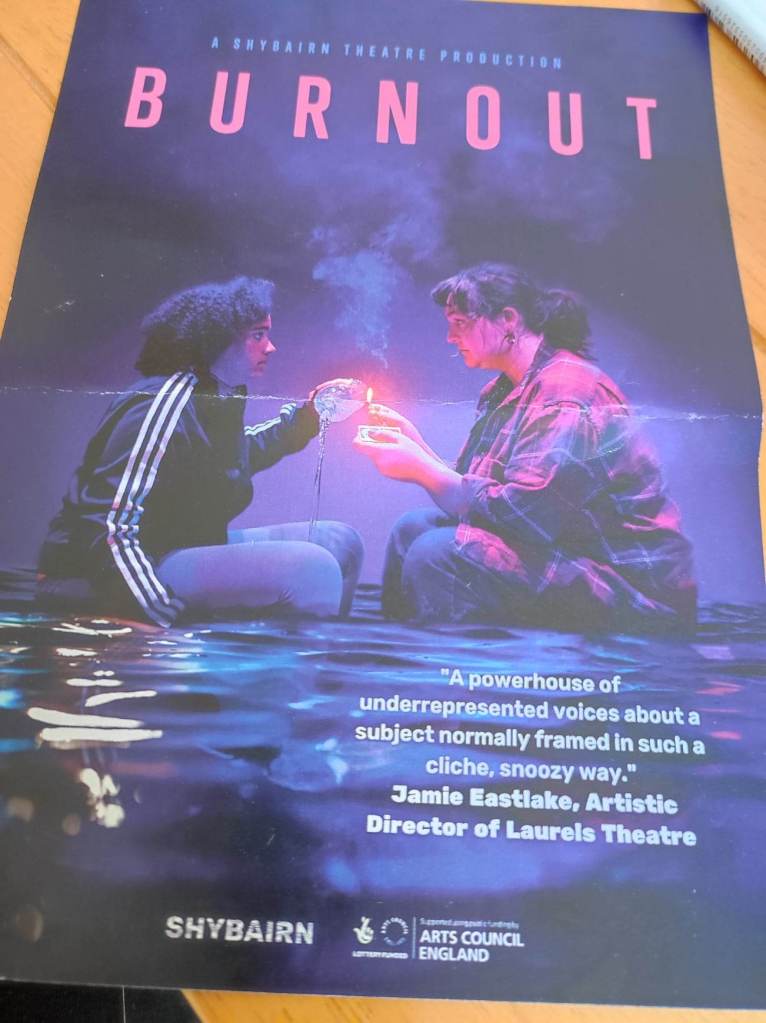
Both Chirwa and Wade are incredibly engaging performers, playing multiple roles and often breaking the fourth wall, leaning into the production’s messy, chaotic energy. While there’s not much in the way of subtlety in the show, and sometimes it feels like it’s taking aim at easy targets (it’s not hard to get laughs by skewering a bunch of clueless poshos), the humour gets the points across well. (The ‘Imagine’ singalong might be one of the most excruciatingly funny things you see on stage this year).
The show is at its strongest when contrasting Amara and Brigette’s desire to make concrete, local changes with the big, bold ambitions of the group – their suggested actions dismissed as ‘thinking small’ – and when the social and economic realities of their lives are pitched against the vaguely sketched ideals of Finnley and his crew.
I remember years ago reading How We Survived Communism and Even Laughed, a book by Croatian journalist Slavenka Drakulić. One particular essay always stayed with me, in part because it was about wearing fur, a subject on which I had always believed there was no morally grey area – there was a wrong (wearing fur) and a right (me). She was querying the morality of Westerners judging those in newly democratised Eastern Europe for wearing fur. Boiled down to its essence, her question was: do those who have had the luxury of getting bored of their privileges have the right to judge those only starting to enjoy theirs? It’s not a flawless argument, but it’s a thought-provoking one, and one that Burnout brought back to me in stark relief. If you’ve spent your life jetting around the world on gap years and foreign holidays, maybe you don’t get to judge people for shopping at Primark and using plastic straws?
But not everything in the production worked for me. Admittedly, I’m slightly biased as I am never a fan of audience participation. Though it was handled well – asking for volunteers rather than singling out people and cajoling them to action – too often waiting for people to come on stage slowed the pace, giving the piece a stop-start feeling that made it feel longer than its compact hour-long run-time. The writing also often felt heavy handed and repetitive in its messaging, vital and urgent as that message is.
But I also suspect I am not the target audience. I can see this show really thriving with a schools or youth audience, where its young protagonist will really resonate, and its anarchic energy can be truly embraced. Because it is a show that deserves a future, as it encourages us to look to our own.
You can see Burnout at Live tonight (3 June) or at South Street Arts Centre, Reading on 7 June.
 ProdigalGeordie