It’s April 2022 and I’m on a Metro to Whitley Bay see a play at a little theatre I know nothing about, more excited if I am honest about the excuse to see the coast than I am to sit through a show about football.

Having lived on the seafront at Brighton for five years, I miss the sea like you wouldn’t believe, so am grateful for any chance to be by the water – but while I was interested to check out a new venue, I can’t say the idea of the play Gerry & Sewell itself particularly enticed me. I liked the film Purely Belter fine (based on the same source material, Jonathan Tulloch’s novel The Season Ticket), but my interest in football stories is limited and my love of Newcastle United was soured in the Joey Barton era and never really recovered.
Still, it’s always a thrill and a privilege to review local stuff for The Stage, since I believe it’s important to spotlight theatre outside of London, and to draw attention to the wealth of talent and new writing my region has to offer. Worst case scenario, I sit through a boring show. Well, had I known then what I know now, at least that wouldn’t be one of my fears. Because I’ve since learned that the one thing Laurels doesn’t do is ‘boring’.
In the end, this first iteration of Gerry & Sewell pretty much blew me away. I expected it to be a laddish story of football stuffed with crude jokes – and, don’t get me wrong, on some level it is a laddish story about football stuffed with crude jokes. But it was also a lot more than that. The design, for a start, was more ambitious than I recall seeing in a fringe theatre, the set so complex and layered it almost rendered the production immersive. Writer and director (and Laurels AD) Jamie Eastlake’s storytelling was funny and humane, and not as macho as I had feared – the female characters felt real and rounded, fleshed out to an extraordinary degree by a sinuous and protean Becky Clayburn, who was unknown to me at the time but has since become one of my favourite performers.
In my 4-star review for The Stage I called it a bold statement of intent for a new theatre, and I was right. Laurels has since proven itself since to be an ambitious venue, willing to stage offbeat and difficult stories. Not perfect, by any means, but a valuable addition to the region’s new writing scene. Where else are we going to get a story about right-wing radicalisation featuring an insane monkey puppet or domestic violence against men based on the human characters in Chicken Run?
When I heard the show was transferring to Live Theatre around a year later – part of Live’s admirable commitment to supporting the North East theatre eco-system with a steady stream of cross-pollination from theatres like Laurels and Alphabetti – I was interested to see how it would work on a bigger stage.
I didn’t expect the material to change much, especially since two of the original trio were reprising their roles – Clayburn and Dean Logan (Jerry), joined by Jack Robertson, who would take over the role of Sewell, with Eastlake still directing. Live is a much bigger space than Laurels – and under AD Jack McNamara it’s made some impressively bold staging choices that use the space with real imagination – but it’s not a big big stage, as such. I’ve seen plenty of small-scale solo shows there that don’t feel swamped, so I thought that Gerry & Sewell would slot right in without much of an adjustment.
Oh, well, just shows what I know. I honestly can’t recall the last time I saw a show so impressively scaled up. All the bits I loved remained, but ramped up to 11 (Clayburn, in particular, was given a chance to let loose and seized it with both hands). Spectacularly designed by The Set Guise (with a full-sized replica of a Metro on stage) the piece was injected with a ferocious, strutting energy and swagger that combined to make it one of the year’s best nights out. So, the question I had last night, when I was headed to see the show again on an even bigger stage at Newcastle’s Theatre Royal, was – could they pull off the same trick again?
The Theatre Royal doesn’t, on the surface, seem the best fit for such a defiantly working-class play. A receiving theatre that plays host to opera and ballet, to the ‘big’ touring musicals and Shakespeares when they are in town, with its fancy décor, higher prices and on-the-door bag searches, it can be pretty intimidating if you are more used to the less formal setting of the city’s other theatres.
To the theatre’s credit, though, they recognise this, and seem intent on tackling it as best they can within their own remit. The recent opening of the Studio Space, which can host smaller plays by local companies, and the theatre’s move back into co-producing – first with Pride & Prejudice (Sort of) and now this – all speak to a determination to become more than just a fancy venue for big shows to visit, but instead to become a cultural hub that supports the region’s talent and welcomes the region’s audiences, in all their variety.
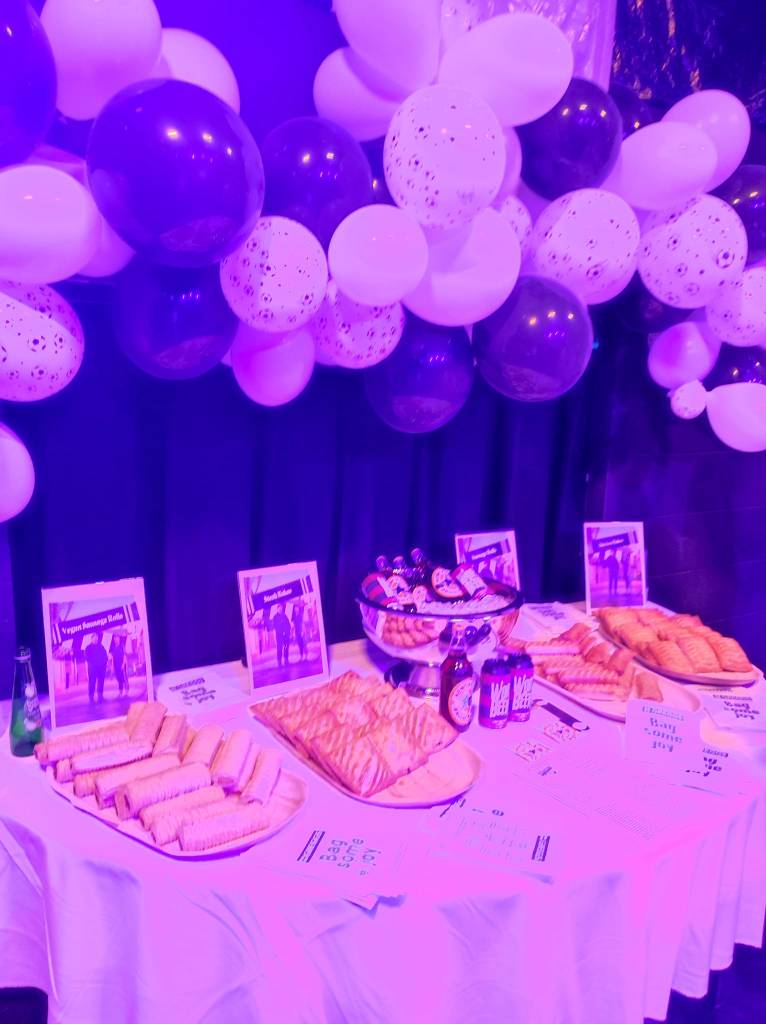
Certainly, this felt on display last night. While obviously, I was lucky because I got to go to the press night party – catered to my plus one’s delight with Gregg’s pasties, doughnuts and glasses of Newcastle Brown Ale – the theatre was adorned with black and white football strips and flags, no hint of stuffiness in sight. It felt lively and welcoming. It felt fun.
The play itself has scaled up again. The central trio remain, but the parts that were previously multi-roled by Clayburn have been expanded into a bigger cast: former Liberty X star Michelle Heaton as Gerry’s mother (yes, there’s a joke in there about that), soap star Bill Ward as his feckless father, and Erin Mullen as his tragic sister, Bridget. (Fear not, Clayburn fans – she still gets plenty to do).
In truth, my favourite version remains the Live production – it perfectly hit my personal sweet spot of ambition and intimacy in a way that simply can’t be replicated in a larger venue. But I can see why it was necessary to change it for a much bigger audience, and I can’t fault the way it was done.
All of the cast excel in this new production. Mullen and Heaton are sympathetic as the doomed women who provide the only softness in Gerry’s life, while Ward perfectly captures the mawkish sentimentality of a man who sees himself as a tragic figure, without having the self-awareness to realise in reality he inflicts tragedy on everyone else (the scene where he insists on singing a mournful Jimmy Nail song encapsulates this so perfectly I actually winced).
The ensemble is fleshed out and given a raucous energy by a huge community ensemble – a Romeo and Juliet dance-off between a Sunderland and an NUFC fan was a particularly sweet moment. (Props are due to the multi-talented movement director Lucy Curry (who, as half of theatre company Peachplant, is just off a successful run at Laurels for the company’s play Subterranea: does the woman ever sleep?)). The Set Guise make a triumphant return, as does the life-sized Metro. There’s even a very cute dog puppet (designed and made by Georgia Hill). The result is a production that pretty much blows the doors off.
From the anarchic chaos of the flag-waving opener – complete with an exhortation that it’s not just OK but encouraged to film that bit on your phones – this doesn’t feel like a play you would normally expect to be staged at a theatre like this. But in all its defiant swagger and unapologetically working-class tones, it’s also asking: why shouldn’t this story belong here? Why shouldn’t we hear Newcastle voices on the city’s biggest stage? To its credit, the Theatre Royal is listening. I can’t wait to see what it does next.
 ProdigalGeordie